Describe Batholiths and Explain Where and How They Form
Extrusive features such as volcanoes are as a result of explosiveviolent activity but they also include more minor. Molten rock that reaches the surface to form landforms are extrusive features and molten rock that is injected into the crust is intrusive.

Batholith Geology Characteristics Formation Video Lesson Transcript Study Com
Batho means depth and litho is rock.

. This batholith forms the core of the Sierra Nevada mountain range. Batholiths may form areas of high land as the material around them is removed by weathering and erosion. Granite and rhyolite are similar in that they have the same mineralchemical composition.
Batholiths are large areas of intrusive usually granitic rock typically associated with subduction zones or hot spots. The plutons that form deep beneath Earths surface represent the majority of igneous activity on our planet. Batholiths are large masses of intrusive igneous rock that form and cool deep in the Earths crust and this quizworksheet combo will help you understand.
Fissure eruptions produce massive floods of low- viscosity silica- poor lava from large cracks in the crust. So batholith is a large mass of intrusive igneous rock that can be as large as 100 square km. Although they may appear uniform batholiths.
By definition a batholith must cover at least 39 mi 2 100 km 2 although most are even larger. A batholith from Greek bathos depth lithos rock is a large emplacement of igneous intrusive also called plutonic rock that forms from cooled magma deep in the Earths crust. Usually these rocks are a formation of cooled magma deep in the Earths crust.
That pluton magmas rise in detached balloonlike forms through the crust frequently reach ing the earths surface and coalesce into shallow and fairly thin complexes. Synthesizing plans uh they consumed CO two and form 02 Thus creating an oxidizing environment for in the results of this is that many transition metals are now in the form of metal oxides. Intrusive volcanism is a type of activity where magma is forced into the rocks that make up the crust of the Earth and when with time it cools and later becomes solid but still remains underground this leads to the formation of different features such as plutons.
Batholiths in particular are the largest and most complex of these plutonic formations. They may be formed simply by being deep beneath the Earths surface subjected to high temperatures and the great pressure of the rock layers above it. Batholiths form from magmas generated in the upper mantle and lower crust beneath any depths exposed by erosion.
Obsidian is likely felsic. They have a planar base but a domed upper surface above which the country rocks are arched up. They are different in that granite forms when magma cools intrusively.
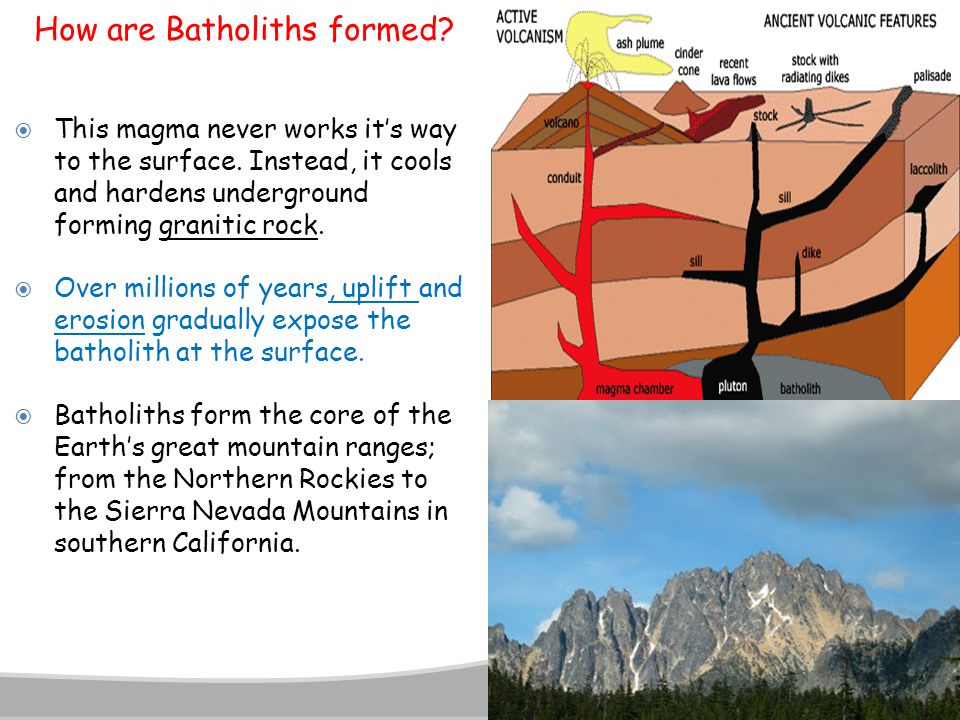
Compare and contrast these intrusive igneous structures. These penetrate up through the ground and cause plutons and explosive cone volcanoes as shown in the diagram. An example of this is the Sierra Nevada Batholith in eastern California see photo below.
They are the result of many many surges over long periods of time all frustrated and subjected to the same burial only to share their eventual resurrection. Dikes sills batholiths stocks and laccoliths. Describe and explain the formation of minor extrusive and intrusive landforms.
Batholith comes from Greek culture. And that gneissic terranes form. Batholiths are typically formed when a number of stocks coalesce beneath the surface to create one large body.
The maximum of batholiths is made of felsic or intermediate rock types like quartz monzonite granite or diorite. Identify and explain two possible mechanisms that can. The main difference between batholith and laccolith is that batholith is a large irregular mass of intrusive igneous rock that has melted or forced itself into surrounding strata whereas laccolith is a mass of igneous or volcanic rock found within strata which forces the overlaying strata upwards and forms domes.
Describe two ways in which batholiths intrude into existing rock. Landscape Evolution in the United States 2013. Some of these sediments are partially subducted but the dissolved water lowers their melting point so they form a molten mass called a batholith.
Laccoliths are lens-shaped and normally 12 km at the thickest. What are the two ways metamorphic rocks form. Batholiths are large bodies of intrusive igneous rock.
Therefore granite has a phaneritic texture while rhyolite is formed extrusively and so has an aphanitic texture. Due to intrusive volcano activity intrusive igneous rock formation occurs here. Part of the Sierra Nevada Batholith photo by Jon Sullivan Related Pages.
As concordant bodies laccoliths and lopoliths are variants of sills. As a result they form sprawling and diverse towers over many hundreds of miles. They form when the stiff cold rock above a magma chamber cannot be supported and collapses to create a broad bowl- like depression.
Some examples of metamorphic rocks are gneiss slate marble schist and quartzite. Many batholiths cover hundreds to thousands of square miles. Intrusive rocks are characterized by large crystal sizes and as the individual crystals are visible the rock is called phaneritic.
Intrusive Activity Batholiths are thought to have formed as a result of continental-continental and oceanic-oceanic convergence. Batholiths are almost always made mostly of felsic or intermediate rock-types such as granite quartz monzonite or diorite see also granite dome. Formed when magma cools and crystallizes beneath Earth s surface batholiths are the largest type of pluton.
These form at mid-ocean ridges and act as feeders to the overlying lava flows that erupt in the axial rift valley. Answered by Geography tutor 2510 Views See similar Geography A Level tutors. What are volcano rocks.

Define The Following A Batholiths B Dykes C Sills D Lopoliths E Laccoliths Geography Topperlearning Com O3imzwtcc
Intrusive Igneous Activity Ppt Video Online Download

Batholith Geology Characteristics Formation Video Lesson Transcript Study Com


Comments
Post a Comment